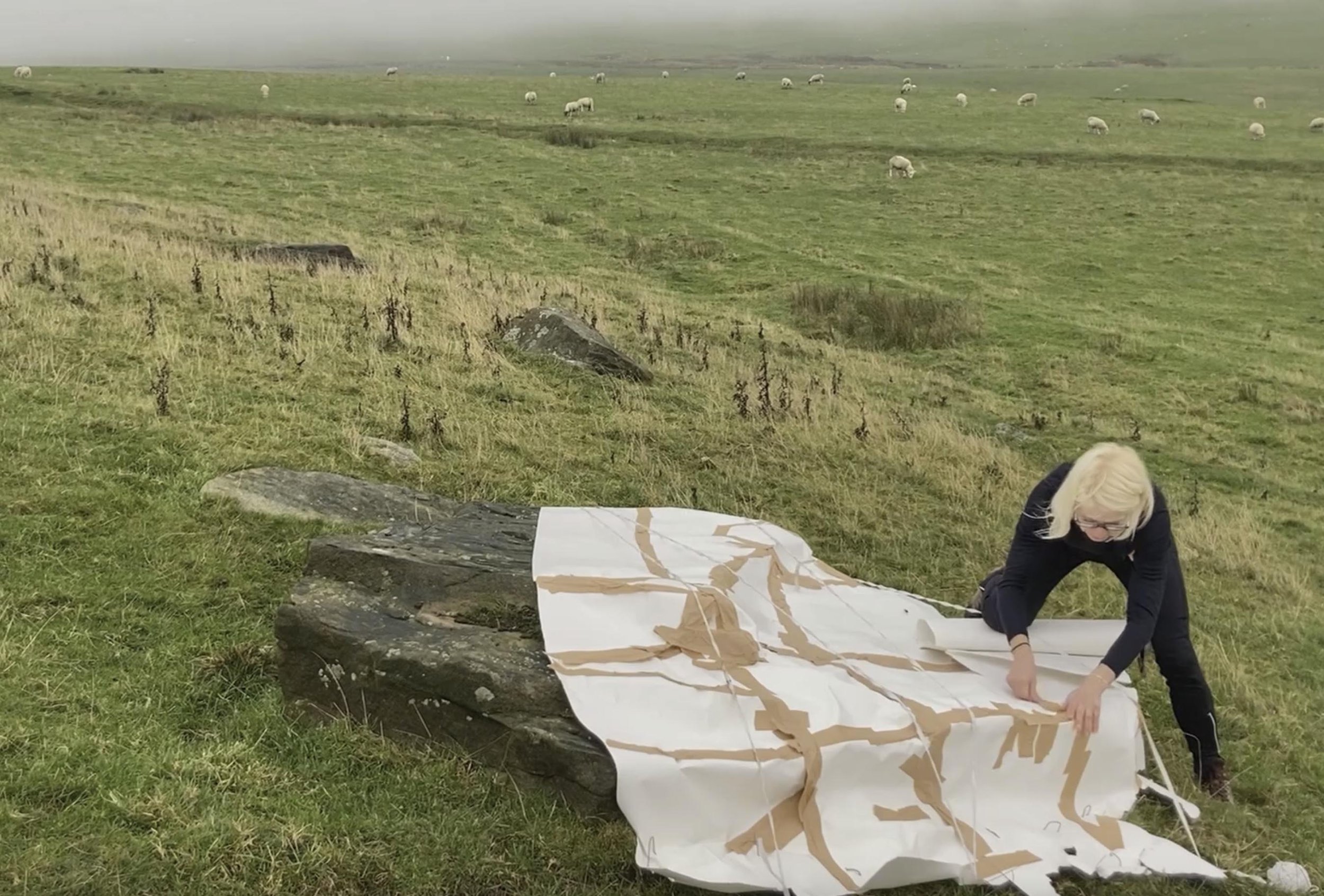
Making a rock cover on Bakestonedale Moor, Pott Shrigley
I am a visual artist based close to Macclesfield in the UK, but I spent the first 30 years of my life in Germany. My arts practice originated from my fascination with drawing and my education as a fashion designer. Over the years, drawing and the human figure have remained the focus of my artmaking but my intentions and methods of working have undergone a lot of changes. My reasons for making drawings changed as did the ways in which I creatively engaged with the sculptural dimensions of the human figure. Whilst making drawings as a means to document what I see and how I feel, has always been an intention and purpose in its own right, using linear marks on surfaces has become a very diversified activity with different goals, in different contexts and with different materials.
Designing garments, drawing the human figure, revealing or hiding some of the sculptural aspects of the body has been a fascinating engagement that brought to the fore further themes, e.g. how garments are our outmost sculptural boundary to the world and mediate how we feel about ourselves and how we experience our movements. Fashion Design connects to and uses the techniques of our material cultures for producing textile surfaces and tailoring these into three-dimensional shapes. The methods of tailoring and apparel production have since become an important reference point for my practical work with fabric and paper and when I compare it to other methods where different materials become assembled into larger sculptural units, e.g. in book-binding, carpentry or creative sculpture work.
After having worked as a fashion-designer in sportswear and as an illustrator, I decided to turn away from the world of applied artmaking in design contexts and instead I chose to explore drawing, painting and making three-dimensional things from the viewpoint of fine art. I developed a unique way of making pictures in which I made hand-stitched drawings using thread and needle on transparent fabric and combined this stitched image with a painting on canvas - both image layers where positioned at a distance and on top of each other and are held together by the picture’s frame. Making such hand-stitched drawings felt like crafting a slowly emerging visual story within the environment of colour and texture as provided by the backing painting. Towards the end of this phase of working, I became curious to explore further how drawing might be brought in connection to the three-dimensionality of an environment: projecting images from a video projector onto the surfaces of an indoor environment worked with connection between image and space. And, as a consequence, I became interested in the events that might happen in a room…. People moving around, music getting played. Video projections as extensions of drawings became connected to things happening in space, all of which could be understood as a performance. The temporal dimension of unfolding events correlated to the temporal aspect of making a drawing, where one mark is followed by the other. Though such work might have been classified as performances and installations, ‘drawing’ as a process still remained a practical and theoretical reference point for contexualising my artmaking. However, now, drawing was understood in a wider context, as ‘expanded drawing’, where the linearity of unfolding events stood connected to the actions of human (and other-than-human) actors, and where activity leads to changes of material contexts: rain ‘draws’ and leaves marks on inky surfaces, or, my repeated drawing actions outdoors lead to the gradual development of different paper-constructions that act as drawing supports for outdoor use. The concept of ‘inscription’, where activity by human or other-than-human actors (a person leaving footprints on the ground, erosion producing deep clefts in landscape…) manifest in the materiality of the world has become a key term to describe the wider context of the original drawing activity. I started to understand the human body as a tool that leaves marks and implements changes on outdoor surfaces or in any three-dimensional environment, leaving traces, assembling materials and ultimately building material culture and practice. Such an understanding of mark-making and inscription culminated in my recent practice-based PhD project at the University of Chester in which I developed a new arts practice by responding to the particularities of the outdoor environment of the British Peak District.